
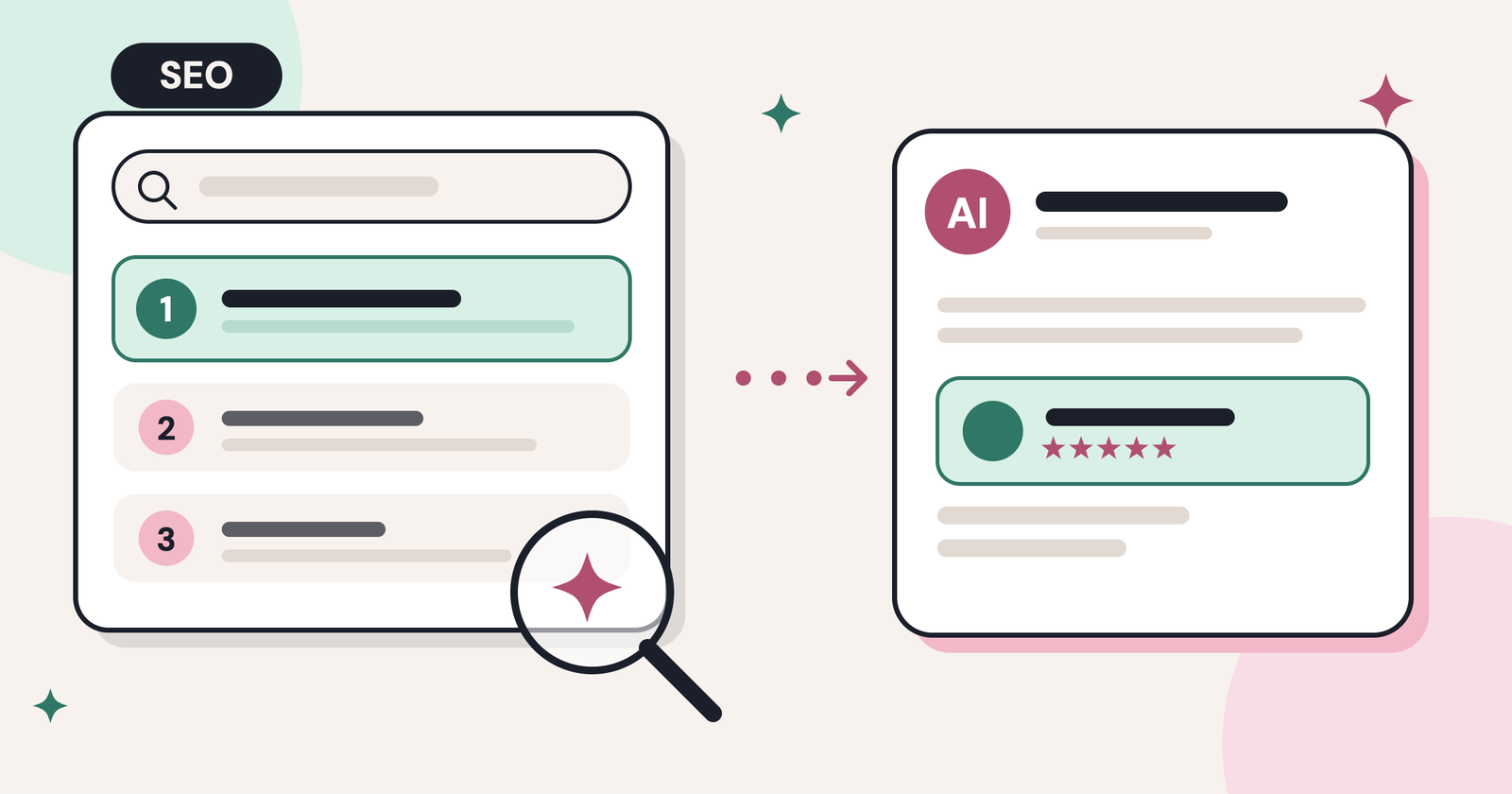
Every few months, or even weeks, someone posts that SEO is dead. With AI tools rising and becoming part of everyday life, answering questions on their own, it’s easy to see why people buy it. We don’t think so. We believe that SEO matters more now than it ever has.
Here’s what actually changed: people search differently. They ask questions the way they’d ask another person, they keep going with follow-ups, and they often get a written answer before they click on a single thing. That shifts how people behave, and it means getting the fundamentals right matters more, not less.
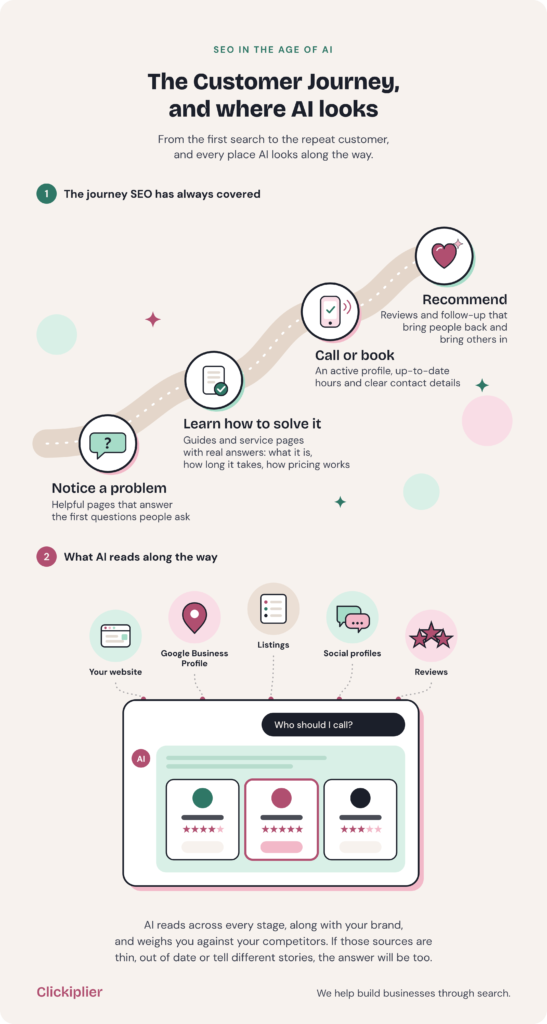
And here’s the part that is significant for your business. AI tools build their answers from whatever they can find about you: your website, your Google Business Profile, your listings, your social profiles and your reviews. If those are thin, out of date or tell different stories, the answer about your business will be too. It’s a bit like a reference check you didn’t know was happening.
What has changed
A lot of people will type something like “personal injury lawyer Chicago”, even with AI tools. The difference is what comes next. Instead of scrolling through a list of links, they follow up: “Do I really need a lawyer?” “Is anyone near me?” “Do they charge anything upfront?” “What are the steps?”
Behind the scenes, AI tools often break each question into several smaller searches: what to do after a crash, which local lawyers handle it, what their reviews say, how fees work. They pull those pieces together into an answer, and when the person asks a follow-up, the whole thing runs again. It’s less like a search and more like a conversation. People call the splitting part query fan-out. Fancy name, simple idea.
For a local business, that means different parts of your online presence get read for different parts of the question. Your service pages answer what you do. Your Google profile answers where you are and when you’re open. Your reviews answer how well you do it. A gap in any one of them can leave a gap in the answer.
Here’s the thing, though: it sounds new, but it really isn’t. SEO has always touched every stage of the marketing funnel, from someone first noticing a problem, to learning how to solve it, to calling or booking, to coming back and telling others. That’s how we approach it: good SEO guides people through all of those steps. If your business has been doing SEO properly, you’ve already been doing this.
Brand has always been part of search too. Even a plain “dentists in Chicago” shows names, reviews and ratings. What’s newer is that AI puts it all together in one place, weighs you against your competitors, and hands the person an answer about who to pick. So how you describe yourself, what others say about you, and whether it all lines up are now being read side by side.
What has not changed
The foundation is the same. What made a business easy to find and easy to trust before AI is still what gets it surfaced now: clear pages, accurate details and a real reputation.
Google says as much. There are “no additional requirements to appear in AI Overviews or AI Mode” beyond the basics for Search. It also says it doesn’t treat “AEO” or “GEO” as something separate from SEO, and that special AI files such as llms.txt don’t help in Google Search.
Google is the one that spells this out. Other AI tools don’t publish their rules the same way, but they draw on the same kinds of sources.
That said, it isn’t set and forget. Keep an eye on what AI tools say about you, and the five-minute check below is an easy place to start.
The fundamentals to set right
Here’s the list we’d hand to any local business.
- A page for every service, with real answers. What it is, who does it, how long it takes, how pricing works, and where you are. A page with a phone number and two lines gives an AI tool nothing to work with.
- The same business details everywhere. Name, address, phone and hours should match on your website, your Google Business Profile and your listings. Google says to keep Business Profile details current.
- A Google Business Profile that is alive. Correct hours and services, recent reviews, and replies to them. An abandoned profile is the online version of a dark storefront.
- Original, first-hand content. Your own experience, photos of your team and your work, and answers to the questions your customers actually ask.
- Named people. Who the owner, the dentists or the attorneys are, with a short bio. People trust a face, and so does a summary that has to say who you are.
- A site that is easy to read and crawl. It should work well on a phone, put important information in text, and not hide pages from search.
Mistakes we see often
We see these again and again when we look at local business websites.
- Thin service pages. A few lines and a phone number, with no answer to how long, how much or what happens next.
- Two sites saying the same thing. Google has to pick one, and the reviews and links you earn get split between them.
- Buttons that go nowhere. A review button or a language link that does nothing tells a visitor, and a machine, that nobody is looking after the site.
- Pages made in bulk. Dozens of near-identical city pages. Google calls this scaled content abuse and treats it as spam.
Most of these come from a website that was built once and then left alone. It happens to almost everyone, and it’s easy to miss from the inside, because you know what you meant the page to say. A visitor, or an AI tool, only sees what’s actually there.
A five-minute check you can do today
Grab a coffee. This takes about five minutes.
- Ask Google the question a customer would ask, such as “best [your service] near [your area].” Note whether you appear, and what the AI summary says.
- Ask an AI tool the same question. Does it name you? Is what it says about you correct?
- Open your Google Business Profile. Check the hours, phone number, address, services and latest reviews, and whether you’ve replied to them.
- Open your website on your phone. Can you find your hours, a phone number and your main service page in ten seconds?
- Search your business name. Do the address and phone number match everywhere you appear?
Write down what you find. Every wrong or missing answer is a task. And don’t panic over one odd answer: AI answers can change from one try to the next, so ask twice and look for patterns, not one result.
Why we start with SEO
We keep coming back to the same idea. SEO isn’t a trick or a one-time project. It’s the groundwork for everything else you do online.
When your pages answer real questions, your social posts have somewhere useful to point and your reviews have something solid to support. AI tools will keep changing, and we’ll keep changing with them. A business with clear pages and a real reputation is in a good position whichever way things go. That’s why we see SEO as the place every digital strategy starts.